Cooling people, not the air
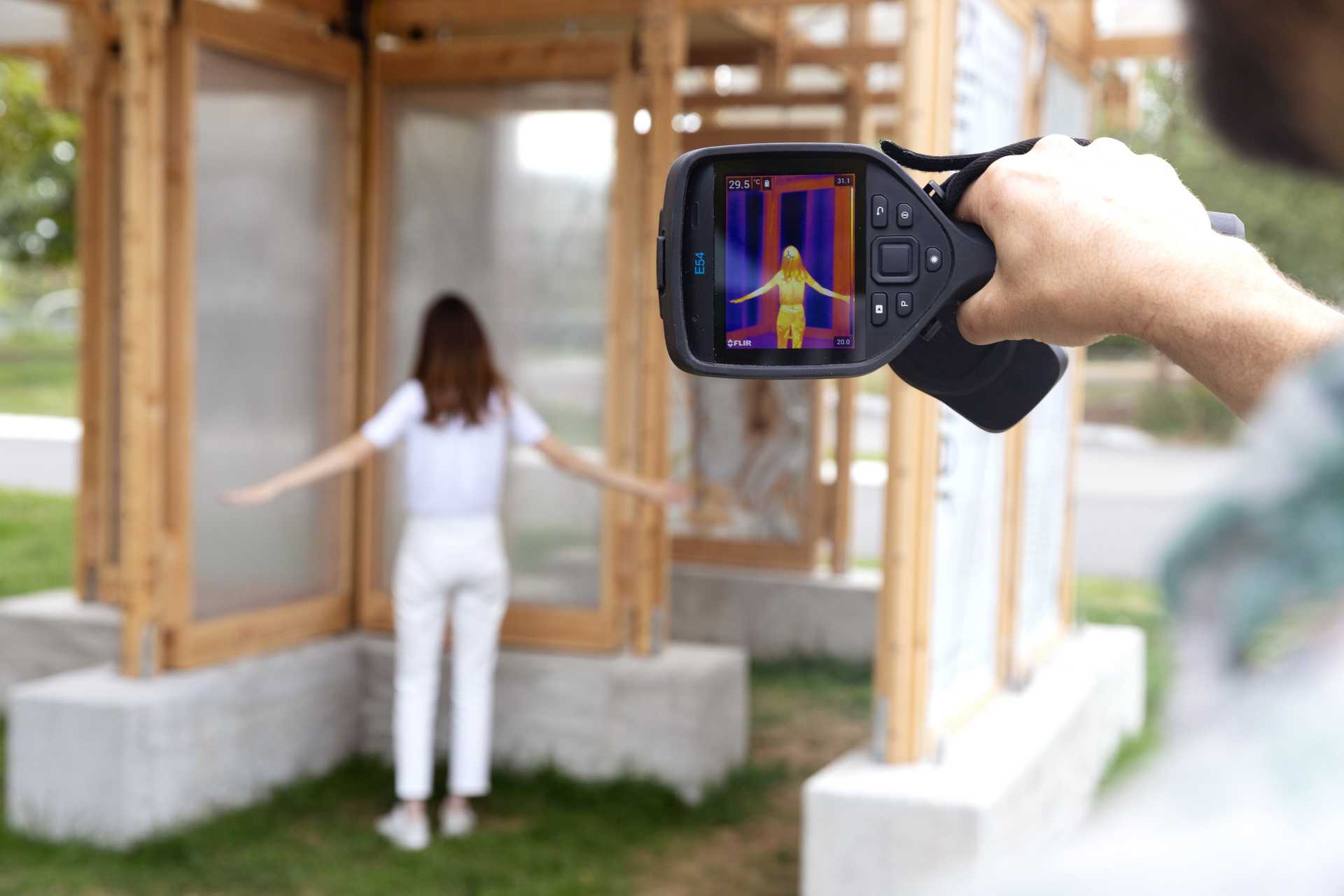
Cities across the globe are experiencing intensifying heat, putting public health and energy infrastructure under growing pressure. While conventional air-conditioning systems are the current, accessible answer, they increase energy demand and increase waste heat in already overheated environments. Experts from Henning Larsen and Ramboll partnered with the University of Pennsylvania to develop KlimaKover, a modular timber pavilion designed to help the New York City address well-being and comfort amidst rising urban temperatures.
New methods in cooling
KlimaKover uses a membrane-assisted radiant cooling system developed by the Thermal Architecture Lab at the University of Pennsylvania’s Weitzman School of Design. Chilled water circulates through microtubes enclosed in transparent radiant panels, drawing heat directly from the body. The panels’ protective membrane allows infrared radiation to pass through to prevent condensation, enabling them to operate in hot and humid conditions. Fabric shading also reduces heat exposure while maintaining open-air conditions, letting natural breezes enhance the cooling effect. The whole system can operate on solar power and requires no external water, making it self-sufficient and low impact.
Designed for disassembly
The pavilion’s modular design allows it to be scaled, reconfigured, and adapted to different urban contexts. Its 4x4 foot roof units can be deployed individually or combined, supporting both temporary installations during heat events and permanent integration into public spaces such as schoolyards, bus stops, and construction sites.
All KlimaKover’s technical components — including solar panels, chiller, water tank, and piping — are left exposed, making the inner workings of the cooling technology visible to visitors. The lightweight post-and-beam frame is constructed from timber salvaged from fire-maintenance and mitigation projects. Photovoltaic panels powering the radiant cooling system were repurposed from decommissioned installations, reducing waste and supporting circularity in materials and energy.
Scalable impact
KlimaKover is designed to explore new possibilities for low-energy outdoor cooling. Beyond public installations, scaled versions could provide relief in heat-vulnerable communities, high-traffic urban spaces, work environments, and temporary events. The technology could also be adapted to emergency shelters, retrofit older residential buildings, or unconventional uses such as protecting animals in high-heat environments.
In an already-strained grid, rethinking how cities provide cooling during high heat is critical. KlimaKover demonstrates a practical, low-energy approach that enhances public wellbeing while simultaneously reducing reliance on energy-intensive infrastructure, showing that adapting and providing accessibility to cooling amidst rising temperatures is possible.
The project was funded by the Ramboll Foundation and the first full-scale prototype was installed on Governors Island in 2025 as part of the city’s Climate Piloting Program.
Huge thanks to our partners on the project, University of Pennsylvania's Thermal Architecture Lab, which provided research, design simulations, and pilot evaluation for the pavilion. The project is funded by the Ramboll Foundation. Additional contributions to the Governors Island pavilion come from AIL Research, Fast+Epp, SKANSKA, SITU, Trust for Governors Island, Cambium, Mecho, Springs Window Fashions, Ontility (a brand of TERREPOWER), KM Associates of New York, Inc., and Tectonic Engineering.
RELATED PROJECTS
Accommodating growth and liveability in Toronto
Rapid population expansion is often detrimental to urban liveability. The new sustainable neighbourhood of Downsview in Toronto steps up to the challenge through a combined focus on people, place, and nature.
SW-Buzzard Point flood resilience strategy
Helping the US capital develop a flood resilience strategy protecting local communities from extreme rain events, with an integrated network of Blue/Green Infrastructure.