Designing a future-oriented hospital in Eskilstuna
Upgrading outdated facilities
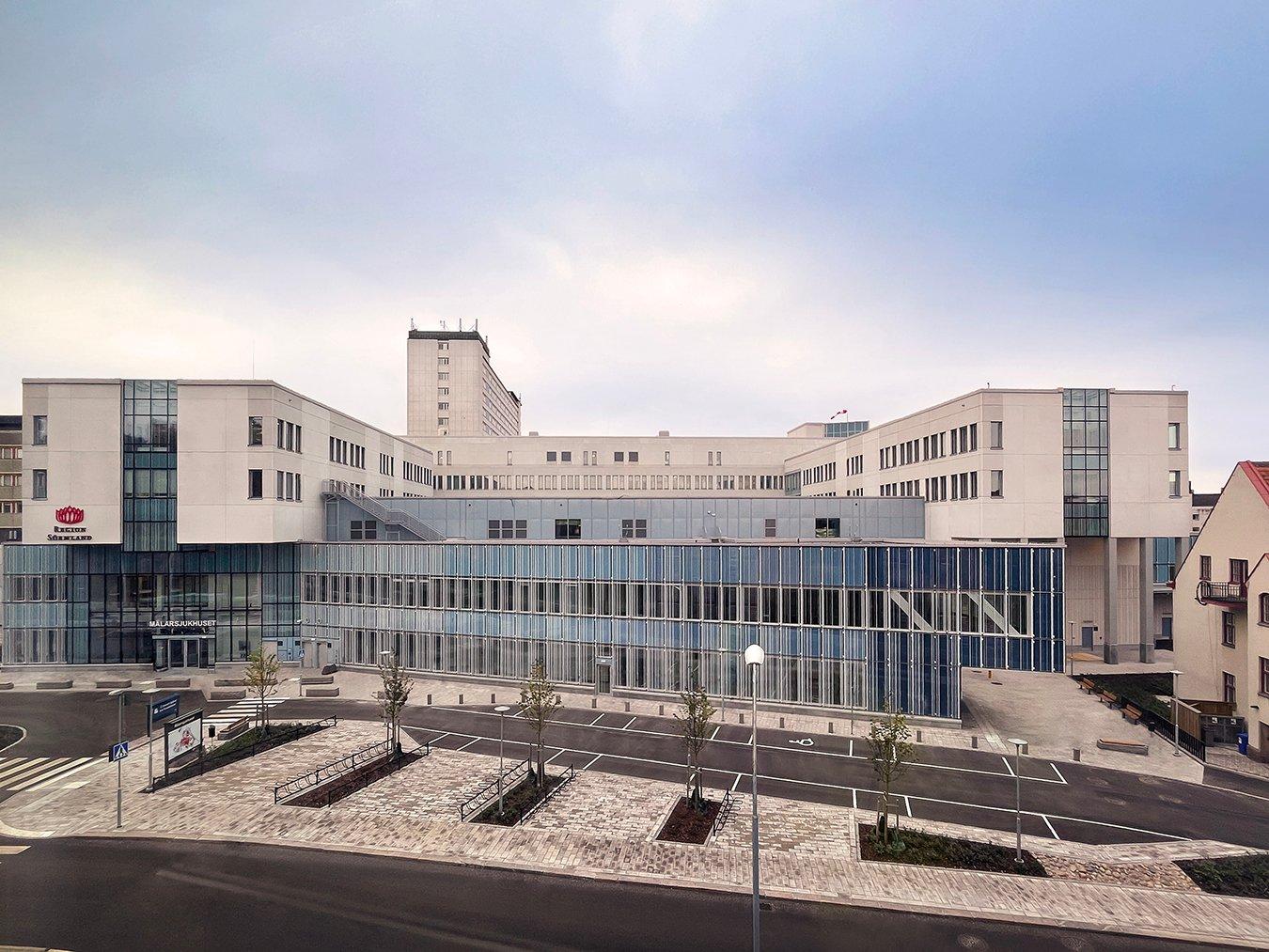
Most of Mälar Hospital's facilities were outdated, with technical systems dating back to the 1960s that did not meet modern standards for building services, surface areas, and energy efficiency. Consequently, Region Sörmland launched a substantial modernisation project at the hospital to accommodate the future evolution of healthcare.
The authorities sought Ramboll’s expertise, and in 2017, Ramboll assembled a multidisciplinary project team responsible for designing the new E62 building at Mälar Hospital, fostering a strong partnership with the operations department and healthcare representatives over the years.
The new building houses some of the hospital's most technologically advanced facilities. These include 14 operating theatres, inclusive of hybrid and incision theatres, three ECT theatres, a sterile centre, an emergency department with emergency radiology, ambulance intake and helipad, an intensive care unit, a cardiac intensive care unit, an emergency care unit, a delivery suite, a neonatal unit, and a women's clinic.
Ramboll’s scope of work encompassed the feasibility study, conceptual design, schematic design, detailed design, as-built documentation, and technical support. The design phase concluded in 2021, and the facility was scheduled for commissioning in 2025. The first patients are expected to be admitted in 2026.
The entire hospital was provided with a new power supply and a new logistics system, which required extensive coordination with Ramboll's consultants. The assignment also involved careful planning of connections, evacuation, and other adaptations to existing hospital buildings.
Experts from various Ramboll offices collaborated on the project, ensuring efficient coordination across disciplines and with suppliers and the contractor, NCC. The team provided comprehensive design and coordination services, including:
- Electrical engineering (power supply, telecommunications, drainage, lighting, lifts)
- Mechanical, Electrical and Plumbing (MEP) design (ventilation; pipes for tap water, wastewater, heating, cooling, process cooling; sprinklers; medical gases)
- Structural engineering
- Water and drainage systems
- Landscape design
- Traffic engineering
- Environmental coordination, including building inventories and contaminated land assessments
- Energy coordination
- Geotechnics
- Building Information Modelling (BIM) coordination
As nearby facilities remained operational during construction, patient safety and system redundancy were top priorities.
Sustainability at the forefront
The newly constructed section adheres to stringent environmental building standards, resulting in energy-efficient, well-insulated structures with high-performing technical systems. These systems were meticulously engineered to ensure the lowest possible life cycle cost, utilising LCC (Life Cycle Cost) and LCA (Life Cycle Assessment) calculations on selected components.
Ramboll also focused on the indoor climate of the project, contributing to the design of window and facade solutions as well as sun shading systems to reduce overheating and cooling needs. The technical systems were designed to create an optimal indoor climate with high energy performance and to meet the hospital's strict hygiene requirements, among other things through needs-based control. In addition, the premises and the technical systems were designed to enable future business adaptations and renovations, which is resource efficient as larger parts of the systems can be reused. This reduced the need for resources in the form of materials, waste, and money, making them more sustainable and climate efficient.
Ramboll's team has contributed with extensive experience from hospital design and collaborated across several locations. Since the care and operations representatives were in close contact with the designers, they had a great influence on, for example, placements and technical solutions.